Safety-Pin
The Safety-Pin is a small, everyday object that, in the course of Gaston Leroux's The Phantom of the Opera, is transformed into an instrument of both farce and dread. It appears at a moment of high tension between the two joint managers of the Paris Opera House, Firmin Richard and Armand Moncharmin, who have been systematically robbed by the mysterious Opera Ghost. The pin is proposed by Moncharmin as a crude but seemingly foolproof device to catch the thief: he intends to fasten the twenty thousand francs in banknotes to Richard's coat-tail pocket, so that any attempt to remove them would be detected. The pin's subsequent failure—the money disappears while the pin remains stuck in place—becomes the definitive proof, in the managers' minds, of the ghost's supernatural power, and it drives the two partners to the brink of mutual accusation and madness.
The Managers' Desperate Scheme
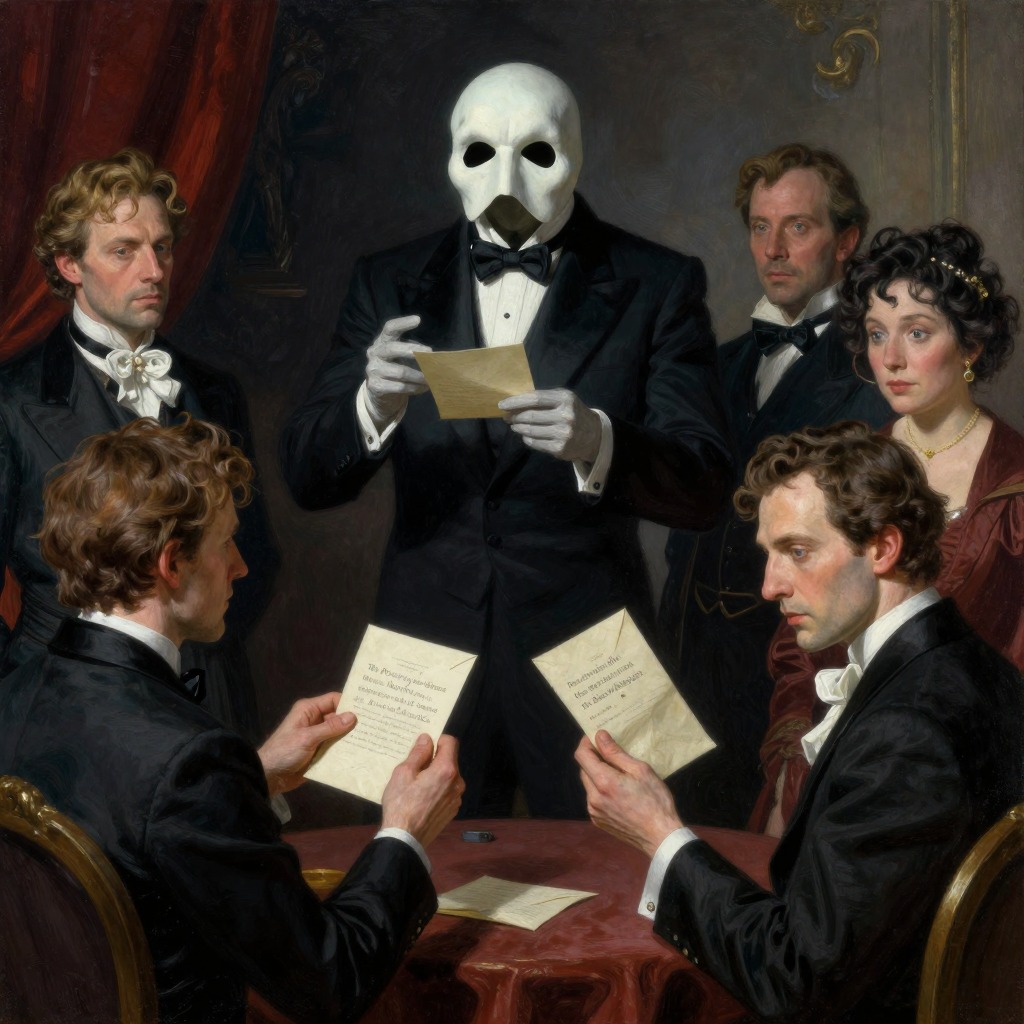
The Safety-Pin enters the story during the interval after the Garden Act of Faust, on the very evening when Christine Daae is abducted from the stage. Richard and Moncharmin, having already lost twenty thousand francs to the ghost in a previous incident, have devised a plan to catch him. They have arranged that Mme. Giry, the box-keeper, will slip an envelope containing the money into Richard's coat-tail pocket, and that Moncharmin will keep constant watch over that pocket. The plan is complicated by the fact that Richard, to recreate the exact circumstances of the earlier theft, must walk backward through the theater, bowing to an imaginary under-secretary of state, while Moncharmin follows close behind, fending off anyone who might come near. The absurdity of the scene—two dignified managers creeping backward through the corridors—is observed by the secretary Remy, who reports their strange behavior to the chorus-master Gabriel, and by the ambassador M. de La Borderie, whom Moncharmin begs not to touch the director.
The Safety-Pin as a Symbol of Mistrust
The Safety-Pin is born of Moncharmin's suspicion of his partner. When Richard, exasperated by the constant surveillance, suggests that if the money were to disappear, it might well be found in Moncharmin's own pocket, Moncharmin leaps up and shouts for a safety-pin. His intention is to fasten the notes to Richard's coat, so that neither of them can be accused of taking them without detection. The pin thus becomes a physical emblem of the distrust that has grown between the two men, who once prided themselves on their partnership. Moncharmin's demand for the pin is so urgent that when the secretary Remy comes to report the extraordinary disappearance of Christine Daae, Moncharmin can only shout, "A safety-pin! Give me a safety-pin at once!" and slams the door in his face. The pin, in this context, is not merely a tool but a symptom of the managers' obsession with the ghost and their growing paranoia.
The Theft and Its Aftermath
Locked in their office, Moncharmin kneels behind Richard and carefully pins the envelope containing the twenty thousand francs to the inside of Richard's coat-tail pocket. He does not seal the envelope, so that he can check the notes at any moment. The two men sit in tense silence, waiting for the clock to strike twelve, the hour at which, on the previous occasion, the money had vanished. When the clock strikes, Moncharmin feels the pin still in place, but the notes are gone. The pocket is empty, and the pin remains stuck in the same spot. The impossibility of the theft—the pin had not been moved, and no one had come near—convinces both managers that the ghost is real. Richard, in a fury, accuses Moncharmin of having taken the money, and the two partners nearly come to blows. The pin, which was meant to be a guarantee of security, becomes the very symbol of their helplessness against an adversary who seems to operate outside the laws of nature.
The Safety-Pin's Narrative Significance
The Safety-Pin episode serves as a comic interlude within the larger tragedy of the novel, but it also deepens the mystery of Erik's powers. The pin's failure to prevent the theft is never fully explained to the managers; they are left with the unsettling conclusion that the ghost can take money from a pocket without disturbing the pin that secures it. This reinforces the theme of Erik's supernatural abilities, which are later revealed to be the result of his mastery of trap-doors, secret passages, and ventriloquism. The pin also highlights the contrast between the rational, bureaucratic world of the managers and the irrational, theatrical world of the ghost. Richard and Moncharmin, who pride themselves on their practical intelligence, are reduced to bickering like children, while the ghost, who is ultimately a man of flesh and blood, outwits them with a simple trick. The Safety-Pin, in this sense, is a symbol of the limits of human reason when confronted with the unknown.